The Real Reason Bitcoin Was Created

When most people hear about Bitcoin, they usually think about one thing: price.
Headlines often focus on how much Bitcoin is worth, how fast it’s rising, or how volatile the market can be.
But very few people stop to ask a much more important question:
Why was Bitcoin created in the first place?
To truly understand Bitcoin, you need to look beyond the charts and understand the problem it was designed to solve.
The Financial Crisis That Sparked an Idea
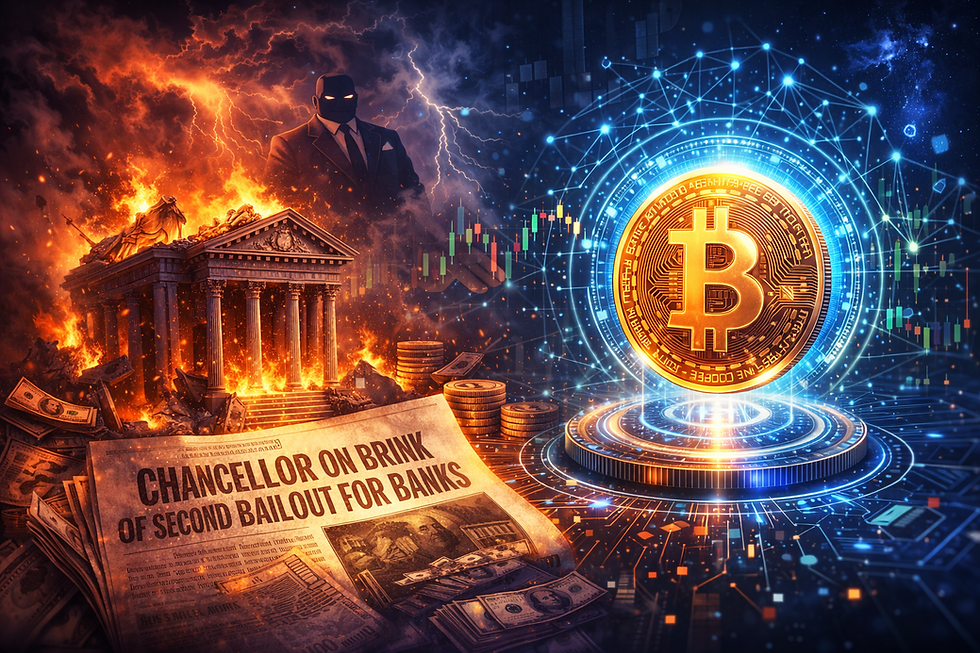
In 2008, the world experienced one of the largest financial crises in modern history. Banks collapsed, governments stepped in with massive bailouts, and millions of people lost jobs, homes, and savings.
Many people began questioning the traditional financial system.
At the center of the problem was a system where:
Banks controlled the flow of money
Governments could print new money whenever they wanted
Ordinary people had very little control over their own finances
It was during this time that an unknown person (or group of people) using the name Satoshi Nakamoto introduced a revolutionary idea.
A New Type of Money
In October 2008, a whitepaper was published titled:
“Bitcoin: A Peer-to-Peer Electronic Cash System.”
This document proposed something radical:
A digital currency that could operate without banks, governments, or intermediaries.
The system would allow people to send money directly to each other anywhere in the world.
No bank approval. No middleman. No central authority.
This digital currency became known as Bitcoin.
The Problem Bitcoin Was Trying to Solve
At its core, Bitcoin was designed to solve three major problems in the financial system.
1. Removing the Need for Trust
Traditional finance requires trust.
You must trust banks to hold your money, process transactions, and remain solvent.
Bitcoin replaced that trust with mathematics and code.
Transactions are verified by a decentralized network of computers rather than a central institution.
2. Limited Supply
Governments can print more money whenever they decide to expand the money supply.
This can lead to inflation, where the purchasing power of money decreases over time.
Bitcoin was designed differently.
Only 21 million Bitcoins will ever exist.
This fixed supply creates a form of digital scarcity, similar to precious metals like gold.
3. Financial Freedom
Bitcoin allows anyone with an internet connection to participate in the global financial system.
This can be incredibly powerful for people living in countries with:
unstable currencies
high inflation
strict banking controls
limited access to financial services
Bitcoin offers an alternative system that operates outside traditional banking infrastructure.
The Hidden Message in the First Block
When the first Bitcoin block was mined in January 2009, it included a hidden message.
The message referenced a newspaper headline:
“Chancellor on brink of second bailout for banks.”
This message is widely interpreted as a statement about the problems within the traditional financial system.
It highlights the moment in history that inspired Bitcoin’s creation.
Bitcoin Today
Since its launch in 2009, Bitcoin has grown from a small experiment among programmers into a global financial phenomenon.
Today Bitcoin is used for many purposes:
a store of value
international transfers
digital savings
financial hedging
Institutions, corporations, and even governments are now paying attention to what began as a small open-source project.
More Than Just a Cryptocurrency
Many people see Bitcoin only as a speculative asset.
But its deeper purpose is much bigger.
Bitcoin introduced the world to blockchain technology, which has since inspired thousands of new innovations in areas like decentralized finance, digital ownership, and global payments.
The idea behind Bitcoin continues to influence how people think about money, trust, and financial systems.
Final Thoughts
Bitcoin wasn’t created simply to become a new investment asset.
It was created as a response to a broken financial system and as an experiment in building a new kind of money.
A system that is:
decentralized
transparent
limited in supply
accessible to anyone
Whether Bitcoin ultimately reshapes the global financial system remains to be seen.
But one thing is certain:
It started a conversation about the future of money that is still unfolding today.
And that conversation is only just beginning.
Want more crypto updates like this?
Sign up for our weekly newsletter for crypto news, quick insights, and short explanations—straight to your inbox.
Subscribe here:


Comments